Monday, July 22, 2019
Answers Come
Monday, May 13, 2019
What Lack I Yet?
"And he answered and said unto him, Master, all these have I observed from my youth." (Mark 10:20)
Perhaps I have kept all of the "big" commandments, but we all have small things that we can change. My problems it not being unaware of my failings, but rather being hyper aware of all the things I can change or do differently. My struggle has always been figuring out what to prioritize.
As I re-read Elder Larry R. Lawrence's talk from 2015 General Conference I realized that I can ask Heavenly Father to guide me.
I am a planner, and I like having the next several minutes, hours, days, and months planned out. I am flexible and willing to make changes, but I like to have a "plan" as a starting place. Unfortunately, I think this tendency has hampered my ability to listen to and follow the spirit in quiet moments. I am so sure of my course that I have been relying on my own will, instead of listening to God's will.
As I sit here trying to make the commitment to seek and follow God's will in the small things, I am confronted with a few doubts:
1.) What if God wants me to figure things out on my own and He doesn't answer my pleas for "What should I do?"
2.) What if I am not worthy of receiving God's will and inspiration?
When I ponder these challenges I realize that these are the doubts I have been facing for years, if not decades. I don't know how to overcome these doubts just yet, but I will focus on overcoming them this week.
What doubts do you face when trying to make a new commitment? Do you sometimes feel unworthy to receive revelation? Do you struggle to know if God wants to you figure things out on your own or if He wants to give you direct revelation?
Saturday, December 29, 2018
Of Distraction, Death, and Driving
Today I was driving home from Arkansas, my childhood home state, where I attended the funeral of my beloved Aunt Shirley. This post isn't really about her, although her life would also be a worthy topic. This post is about more about how when people die we tend to remember better. Driving a long distance (5 hours) gives you a lot of time to contemplate life and the important parts of it. Especially after a funeral, and especially when you listen to General Conference talks the entire trip.
These three things together, the funeral for my aunt, the long drive, and listening to the general conference talks, allowed me to refocus and refine my life. It was a transformative five hours. Hence this essay.
My Aunt is an amazing woman. She left a wonderful legacy here on earth, and is joining an equally fantastic legacy among our ancestors in Heaven. What struck me this weekend is how easy it is to become distracted. I haven't thought a lot about my Aunt's life recently. Honestly, until she traveled to Houston to have heart surgery I hadn't really even though much about her. Not that I don't care, but I have been caught up in raising my own family, tending to my own life. Granted, many of my actions and choices are affected by the influence of my Aunt and her children, even if I am not consciously thinking about the cause and effect relationship that exists between my Aunt and my actions and choices.
As I sat with family and friends this weekend to celebrate the amazing miracle that my Aunt has been, I was reminded of so many gospel principles. The greatest principle I was reminded of was faith. My Aunt was a woman of fierce faith. When she endured radiation for Hodgkin's disease in the 70's, doctors told her that she would not be able to bear children. She said, "We'll see" and proceeded to fast and pray and fast and pray, and eventually had four amazing children who today are my heroes in every way.
My Aunt has endured several health challenges, in spite of her impeccably healthy lifestyle. She had breast cancer, diabetes, defective heart valves (all of these were most likely complications from the massive amounts of radiation she endured in the 70s). But through all of these health challenges she has maintained a patient, faithful, joyful outlook on life, and lived a life of selfless service to her children, nieces and nephews, and anyone else who cross her path. She did not make excuses, and she had good reason to make excuses.
I was humbled this weekend with a self-realization of the excuse making in which I engage. I make a lot of excuses for why this that or the other thing is hard for me to do. A lot of "if onlys"...
I always have some kind of excuse for why I don't do more than I am doing. I have an excuse for why I don't study the gospel like I did before. I make excuses for why I don't attend the temple as regularly, I have excuses for why I don't have patience with my husband and my children. Some of them are pretty good excuses.But what I realized after this weekend is that none of them are valid excuses. There are no valid excuses.
The Savior of the world suffered body, mind, and soul so that there would have to be no excuses. Because of Him and through Him I can be more than I am, and I can do more than I can. Not because I will be amazing or I will work hard, but because through faith in Jesus Christ I can do all things.
I have been distracted from faith these past several years. Maybe the last decade. It is so easy to become distracted from the things that really matter. Faith, endurance, charity, compassion. There are so many things in life that we think are important, and then when someone dies, we have the opportunity to contemplate our lives and our choices and we realize that all of the other things do not matter and what really matters was so simple, and we tried to make it so complicated in the name of philosophy, or deep thinking, or intellectual conversation.
What really matters really is very simple. Christ taught us that. It is in the scriptures. Let's go back to the scriptures and soak up the simple brilliance of the gospel and please let us let go of all the complicated processes that distract us from what really matters.
What things have distracted you from the simple parts of the gospel? What events or things in your life help bring you back to remembrance? How do you remember things without having to go to a funeral?
Sunday, November 30, 2014
I Want To Understand
In conversations about the temple, particularly first temple experiences, at least one person mentions how awkward or strange they found their first temple experience to be.
I have been thinking about this as I have been studying the temple covenants and rituals in the Book of Exodus in the Old Testament. As I read the words of the scriptures my mind turned back to my first temple experience. I didn't understand everything - I still don't - but I remember having a fierce testimony of the importance of the temple before I even went for the first time. I knew that whatever was going to happen in the temple was going to be what needed to happen, and that I would certainly learn things - which is what I always expected I would do in the temple - learn new things.
So I think that there are two keys to a good first temple experience:
1.) A strong foundational testimony of the importance of the temple
and
2.) A strong desire to learn something new every day, an open mind, an attitude that if something seems strange it's probably because you don't understand it completely.
What do you think are the important aspects of preparing for a good first experience in the temple?
Friday, January 3, 2014
An Eventful Year - Revelation and the Lord's Timing
I'm sure you have all been missing me, dear readers. And I just want to warn you that this is not me "coming back" really. I hope to be back eventually, and I imagine the summers will be better, but life has thrown me a few curve balls.
In 2013, I had five major life events: birth of a child, starting school, divorce, new job, and remarriage.
Birth of a Child
There are so many thoughts and feeling that are rushing around inside of me about the birth of my second son. His birth was amazing and spiritual and perfect and wonderful and everything I wanted it to be.Heather, from Women in the Scriptures, was my doula - and she was an amazing doula. She will deny it up and down, but I regard Heather as a spiritual giant. I feel like the labor and delivery went so well because she was there, with her faith and her knowledge and her testimony, I could just feel the power of God around me and with me. And if not from Heather, then from what she has taught me about the priesthood and womanhood and motherhood through the past several years, both on her blog and in personal conversations. She is an amazing woman.
Starting School
I felt inspired this year that I should go back to school to finish the few courses I need to qualify for a teaching license. Although I have a bachelor's degree in Math, I don't have a teaching license, and I had been feeling something nagging at me to get my license and teach. Because I was married to a soldier I didn't know how much time I would have in any one place, so I figured that I needed my education to be as portable as possible. So in May I applied to an online university to finish my teacher prep courses. Because of the next major life event, I am so grateful that I listened to the prompting to go back to school and prepare to be a teacher.
Getting a Divorce
This is probably the longest story, and I am not going to tell it all right here, right now (but you can read my emotions about a lot of it in my previous posts about my faith crumbling through adversity and trials). Suffice it to say that when I was scared to death (literally) of leaving my marriage, when I thought it would be better to be dead that divorced, when I argued with Heavenly Father, wondering why He would ask me to do something I knew was against His plan, when my faith seemed to be threadbare, something happened. I got strength from a place I had forgotten about, and somehow, I got out.
And there I was, hurting, broken, but feeling like I had burst out of a dark prison.
I felt like my life had crumbled around me, but God gave me a vision of what my new life could be if I would just cling to Him. And that is what I have been doing.
Starting a New Job
Due to the previous major life event, I needed to get a job so I could provide for my family. I submitted applications for a job on Monday in between filling out divorce papers. I filed for divorce on Tuesday, interviewed for a job on Friday, and was offered the job on Tuesday of the next week. A full time job teaching math at a middle school in a nice neighborhood about 10 minutes from my house. My good friend was looking for a job and is a fantastic mother and I asked and she offered to be our day care practically at the same moment. It was meant to be.
However, my first paycheck wasn't going to come until late September. Because I had started school I had just received some student loan funds. Between the student loans and my amazing ward I was able to make it to September with money to spare. Heavenly Father is watching out for me.
Getting Remarried
This story is probably longer than the divorce story, but I am pretty sure it can be summed up in two principles: receiving and understanding personal revelation (which I wrote about here) and the Lord's timing is not always our timing - which the Stake President mentioned in that blessing.Did you know that "in due time" doesn't necessarily mean "in a loooong time"? That's what I thought when the Stake President promised me that I would experience the joy of marriage again and followed that promise up with "in due time" which he repeated! I was thinking "so, I'll get married again in a really really really long time. Imagine my surprise when I met my new husband and three days later Heavenly Father informed me that he would be my new husband. Come to find out "in due time" means "at the appropriate time" - which apparently is 3 months after a divorce (for me). Who knew? It didn't take my husband long to receive the same revelation, so then the only question was "when"? We prayed about it and I felt inspired that we should pick a date and take it to Heavenly Father for approval. We looked at my calendar (being a teacher I don't get a lot of time off work) and picked a date mid-January. After a few days I had a nagging feeling that it wasn't soon enough. So we thought "After Christmas would be great". Nope, wrong again. Finally we picked the day before Thanksgiving (which at this point was about a month away). Yep. It felt right. We talked to my bishop, we talked to my parents, we talked to his parents, we told our kids (six of them altogether!), and it happened! So yeah, it all boils down to receiving and understanding revelation and the Lord's timing is not always our timing.
So now you know where I have been for the last 6-12 months. Going through a painful divorce, starting school and a job, and getting remarried to a wonderful man who loves God with all of his heart, might, mind and strength, with me as a close second.
I hope to be able to write more often, but don't hold your breath. Of course, now that I have "come out" and you all know my little secrets, it will be easier for me to write. I always like being open and "real" on my blog, and I feel like I have been lying the past year or so because my marriage was so awful. So, comment on here and tell me you're still reading and I will try to post more often. If no one cares that I was gone I will probably just post whenever it happens (which might not be very often!).
What lessons did you learn last year?
Friday, March 29, 2013
The Stumbling Block of Revelation
Unfortunately, this doctrine of continuing revelation can sometimes be a stumbling block for our testimonies.
Why a stumbling block?
Let's have a little history lesson.
Prior to 1978, the priesthood was restricted to men not of African descent. I won't go into specifics, because they aren't relevant to this post - but just know it was a complicated and strange policy, and many people didn't understand it. Even today, the best explanation we have (officially) is this statement from the Church:
“The origins of priesthood availability are not entirely clear. Some explanations with respect to this matter were made in the absence of direct revelation and references to these explanations are sometimes cited in publications. These previous personal statements do not represent Church doctrine.”In 1978, the Church issued an official declaration, based on revelation, extending the priesthood to all worthy male members of the Church.
Recently I have been hearing members of the Church say that they hope that the Church will eventually embrace same-sex marriage because, after all, the Church was "wrong" once (referring to the priesthood ban). They seem to be viewing the 1978 revelation as a sort of apologetic "Whoops, we were wrong, we're sorry" admission.
Honestly, it's hard not to see it that way, especially given all the personal statements and opinions that were offered as explanations for the priesthood ban, most of which were abhorrent, even in the early and mid 1900s when they were originally offered.
If so many apostles, prophets, and other Church leaders could be so misguided and racist, then might not our Church leaders today be bigots and homophobs? It isn't a completely illogical leap.
Except for one small principle which might help us sort out this whole issue.
At General Conference in April 2012, Elder Christofferson taught:
…it should be remembered that not every statement made by a Church leader, past or present, necessarily constitutes doctrine. It is commonly understood in the Church that a statement made by one leader on a single occasion often represents a personal, though well-considered, opinion, not meant to be official or binding for the whole Church.While any number of racist sounding explanations for the priesthood ban can be readily produced by any proficient Googler, I think you would be hard pressed to find any of these comments listed in proclamation format, signed by all fifteen living apostles at the time of the statement's utterance, and good luck finding teachings by every single apostle since quoting the statements. In fact, most of the apostles either said nothing about the subject of the ban, and few quoted the misguided (in my opinion) statements of their brethren. We must always remember that prophets are still just men. Moses, arguably one of the greatest prophets, was scolded by God Himself. Even Joseph Smith had issues, admitting his youthful indiscretions and at times failing to be content with God's answers to his prayers and requests.
On the other hand, The Family: A Proclamation to the World is a document affirming the sanctity of marriage between a man and a woman, and testifying that gender is an eternal characteristic. This document was signed by every one of the fifteen apostles of Jesus Christ living when it was written, and it has been quoted by every newly called apostle since. I think it is safe to consider the document, and its call to "responsible citizens and officers of government everywhere to promote those measures designed to maintain and strengthen the family as the fundamental unit of society" as being "official [and] binding for the whole Church".
It can definitely be hard to recognize what is revelation and what isn't, what is scripture, and what are the philosophies of man. Again, we can go back to our fundamental belief in revelation - not just continuing revelation through prophets and apostles, but personal revelation. Each and every one of us is entitled to receive our own revelation - as Levar Burton says "But you don't have to take my word for it."
More reading about revelation:
Becoming a False Prophet to Ourselves
Sunday, September 23, 2012
GCBC Week 26: Young Women General Meeting
Each spring, the young women of the world have the privilege of hearing from all of their leaders, and the prophet, in a special broadcast tailored specifically to them. I remember after I turned twelve and entered the Young Women program the thing I looked forward to the most was being able to attend the General Young Women’s Broadcast.
I can’t wait until my daughter is twelve and she gets to attend these meeting as well.
But thanks to the Ensign and other church publications and websites, the messages from the Young Women’s broadcast are available to everyone and the messages are excellent and pertinent to any member of the Church, not just the Young Women.
I felt like it was important to study the YW broadcast talks this year in GCBC. I have been listening to them along with the other General Conference talks, and I really felt the messages from the broadcast speak to me. They are timely messages for all Latter-day Saints, and we should all be studying them.
This week we will be studying the messages from the General Young Women presidency. Next week we will study President Monson’s talk to the YW, and the next week will be October General Conference and the start of the next round of GCBC! (which will be held back at Diapers and Divinity! Make sure after next week you head over there for the posts and discussion)
Thursday, September 13, 2012
The Lifespan of the House of Israel
A verse I read in Chapter 4 stuck out to me. I had never really thought about the relationship between what Jacob had been talking about and the allegory. Turns out there was a reason Jacob quoted the allegory (I think I should probably pay closer attention when I study the Book of Mormon... This is probably not news to anyone but me). In verse 17, Jacob poses the question, "How is it possible that [the Jews], after having rejected the sure foundation, can ever build upon it, that it may become the head of their corner?"
I'd say this is a valid question for anyone who has rejected the Savior at some point in their lives.
Honestly I didn't get very far in Jacob 5 because I got stuck on verse 3 where Zenos says the House of Israel is like a tame olive tree and then he says "and it grew, and waxed old, and began to decay." And I couldn't help thinking "How long does a normal olive tree live?"
So I looked it up. According to various sources (i.e. a Google search) an olive tree lives to be about 2,000 years old.

And that got me thinking some more - how many years was it from the time of Jacob (also known as "Israel") and the time of Christ? (we know the House of Israel was in a state of apostasy by that time).
So I looked that up, too. According to the LDS Seminary Old Testament bookmark (you know the cool plastic bookmark with the chronology on one side and the scripture mastery verses on the other?) it was a little under 2,000 years.

Hmmm... So the House of Israel had about the same life expectancy as an olive tree.
It made the olive tree allegory that much more meaningful to me.
I haven't studied the rest of the allegory yet, but I am interested to see what other connections I will make reading it in the light of the house of Israel having the same lifespan as an olive tree.
Have you ever been reading the scriptures and had a thought - or a question - come to your mind that eventually helped you get more out of what you were studying?
- Posted using BlogPress from my iPhone
Tuesday, August 21, 2012
Eve: The Mother of All Living
Note: This post was originally published on July 12, 2010. I'm still on vacation, but we'll be home today and I'll be back blogging tomorrow, hopefully. If I'm not too worn out from our vacation - you know you usually need a vacation from your vacation. I hope you've enjoyed reading and discussing some of my older posts. Make sure you stick around - we'll be having another giveaway soon!
I have felt inspired to study the mothers of the scriptures. I feel a sacred responsibility to be a good mother, and especially to be a mother to more than just my own biologically borne children. I don’t want to be just a half-rate mother, though – I want to be a great mother who has great compassion and charity and patience for children (and people in general) and who can teach with kindness and gentleness.
The first mother I want to study (and how appropriate) is Eve.
I want to name one of my daughters Eve. I love the name, and I especially love the symbolism – our first parents were Adam and Eve, and Adam called her Eve because she was the “mother of all living.”
In the Garden, when the Lord created Eve, he said, “Therefore shall a man leave his father and his mother, and shall cleave unto his wife: and they shall be on flesh.” (Gen. 2:24) I think Eve was a great example of a mother’s first priority – her husband. The relationship between husband and wife is always a greater priority than the relationship between mother and children. I’m not trying to put down the relationship and role of mother, but I feel that if a woman is being a good wife, she will probably end up being a good mother. Not only does she have to practice patience and humility with her husband, but by cultivating the relationship with her spouse, she will also have a champion and helper when it comes to teaching and having patience with those children.
I know in my own life when I feel more like “one flesh” with my husband, and I am a better mother. When we are “one flesh,” our parenting styles do not clash – our methods actually compliment one another.
Our children are very young (3 and under), and we are only barely forming our parenting styles. Sometimes it is difficult, because we both were raised differently. But then when we’re talking about it, we realize that we both want the same things for our kids. The only place we differ is in how to get our kids there. But when we really think about it, and pray and fast about it, we realize that if we have the gospel of Jesus Christ at the heart of our parenting – if we parent with the atonement and the doctrine of salvation in our hearts – we end up parenting much the same way.
We do what feels right – we parent the way that feels confirmed by the Holy Spirit. And there is no way to feel that Holy Spirit – in any aspect of our family life – without being “one flesh.”
Being unified with my husband is the first step in becoming a good mother.
Eve Part II
In the Pearl of Great Price, it says “And Adam and Eve blessed the name of God, and they made all things known unto their sons and daughters.” (Moses 5:12)
Eve taught her children everything. I think she focused on the principles of the gospel. She taught them everything she knew about God and Heaven and angels and the Savior. And I like that “she made all things known” unto them. It doesn’t say she sat over them while they read book after book after book and did worksheet after worksheet after worksheet. She simply “made all things known unto them.” I like to think that while they were out working in their gardens, tilling the earth, she talked with her children about how faith is like a little seed, and how when we study the words of the Lord and we pray, our faith can grow until it becomes a beautiful tree and bears fruit. That fruit is the works of our spirit, because faith without works is dead.
I like to imagine the conversations Eve had with her children while they were washing their clothes in the stream, when she told them about the Savior that would come and redeem mankind. She probably mentioned how the river washing their clothes was like repentance washing away their sins.
When they sacrificed the first born of their flocks at the alter, I imagine her gently whispering to her children how this was symbolic of the sacrifice the Savior would make to save us from our sins, and further symbolic of the sacrifice we would have of a broken heart and a contrite spirit for our sins.
I imagine that when Eve held her little ones in her lap as she rocked them to sleep, she told them about our Father in Heaven who loves them, and knows them by name, and is watching over them. I imagine that after she rocked them, she knelt with them in prayer, guiding their words to help them speak to our Father in Heaven.
I am going to study more about Eve this week, but I think I am going to focus on making “all things known unto [my] sons and [my] daughters.” I will tell them all about the gospel of Jesus Christ, because I want them to know what I know.
What things about being a mother have you learned from Eve? How to you make things known to your children (about the gospel, every day life, etc)? How do you and your husband deal with conflicting parenting styles?
Wednesday, August 15, 2012
Follow the Prophet
Note: This blog post was originally posted on our private family blog on October 18, 2010. I first reposted it on this blog on March 23, 2011 so that I could refer to it in another post. I am reposting it today because I want to get some more feedback on these thoughts. How do you sustain our prophets when others seem to attack them from every side - and sometimes might even seem to have rational arguments for doing so?
On Sunday, October 3, 2010, President Boyd K. Packer, whom members of the church sustain to be a “prophet, seer and revelator” gave this talk.
As a prophet, President Packer’s responsibility is to call the world to repentance – much like Noah did in his day as he built the ark, like Lehi in Jerusalem, and like many other prophets in the past.
Unfortunately, as they did with Noah and Lehi, the world has rejected the words of the prophets, and have even gone so far as to petition him to withdraw his statements. This is not a new thing. It has happened again and again throughout history, and God’s word has always remained unchanged. As President Packer so bluntly put it:
...there are those today who not only tolerate but advocate voting to change laws that would legalize immorality, as if a vote would somehow alter the designs of God’s laws and nature...There are both moral and physical laws “irrevocably decreed in heaven before the foundations of this world” that cannot be changed...To legalize that which is basically wrong or evil will not prevent the pain and penalties that will follow as surely as night follows day.
I respect everyone’s right to an opinion. But I also believe in God’s word, and I firmly believe in God’s prophets who deliver His word to us – especially in these latter days.
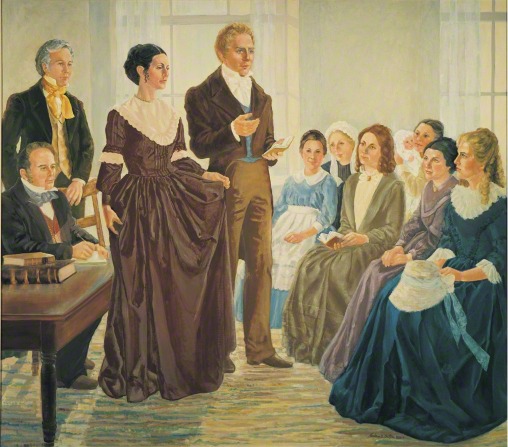
Satan is stirring up the hearts of men. A war is waging. “Who’s on the Lord’s side, who? Now is the time to show...” This particular battle hits really close to home for me. I have had to make some really difficult decisions about some people who are very dear to me. All I can think about is how to “love one another” while still being devoted to righteousness, and not “look upon sin with the least degree of allowance.” This article, a Q&A with Elder Oaks and a member of the 70, has been particularly helpful. I also read something Joseph Smith said in one of the first Relief Society meetings. He said, "God does not look on sin with allowance, but when men have sin'd there must be allowance made for them." We still need to be caring and compassionate - no matter the circumstance.
In response to the petition I mentioned earlier, the brethren had this to say:
Much of this was not new, but there were a lot of really great things said. A few of my favorites:
“As a church, our doctrinal position is clear: any sexual activity outside of marriage is wrong, and we define marriage as between a man and a woman.”
“None of us is limited by our feelings or inclinations. Ultimately, we are free to act for ourselves.”
“The Church distinguishes between feelings or inclinations on the one hand and behavior on the other. It’s not a sin to have feelings, only in yielding to temptation.”
I believe that people have same-gender, or homosexual, attractions, and that they can sometimes be very strong. But those people are still just children of God to me. I believe that there is nothing fundamentally different between someone who struggles with same-gender attraction, and the rest of God’s children who struggle with something else. We are all children of God experiencing trials and struggles on this earth with Satan tempting us and trying us. We inhabit imperfect bodies with imperfect emotions and chemical make ups. We all face trials. (read more about that here)
God made man and woman. He created them specifically different – to fulfill different purposes. From The Family: A Proclamation to the World, “Gender is an essential characteristic of individual premortal, mortal, and eternal identity and purpose.”
As I write this, I realize that I am not writing it to an audience of people who don’t believe in Christ and the atonement. I am writing it in hopes that someone who feels unsure about the word of God on this issue can maybe read my testimony and perhaps feel the spirit and have a little better understanding of God’s word.
It is not easy to stay true to the Savior. Especially in today’s social and political climate. There is so much of the Adversary’s influence in our societies that we can be easily confused by the arguments out there.
Sometimes I get very discouraged because the world is getting more and more wicked – good is called evil, and evil is called good. But I know that there is hope and happiness available to those who live the gospel – for those who earnestly call on God in the name of His Savior, Jesus Christ and ask for a confirmation of that which is true. The Spirit will guide us. I know that because I beg the Lord for His Spirit to be with me as I raise my children - often I feel like I don’t know anything.
If there is one thing I know is absolutely true, it is that God lives and loves us and has given us living prophets on the earth to help guide us when we become confused about how to live in the world and not be of the world.
And I hope and pray that you will try to get that testimony for yourself.
Recommended reading:
Cleansing the Inner Vessel by President Boyd K. Packer
The Q&A with Elder Oaks and Elder Wickman
The Response to the HRC Petition
Many of These Articles
This Proclamation
Another Good Article by Elder Oaks
Friday, August 10, 2012
The Title of Liberty and the Anti-Nephi-Lehis
Note: This post was originally published on November 18, 2010. I was reminded of some thoughts I had in this post when Paul at A Latter-day Voice wrote about the Anti-Nephi-Lehis. I forgot that I had written about it on this blog until I was looking through some of my first posts on this blog and I found this one. I think the story of the ANL's is one worth discussing in depth, and I enjoyed Paul's insights. If you're itching to read something after you read this, head over and check out his post. It was very good.
I was reading in the Book of Mormon last night (and honestly I’ve been in the same chapter for about 5 nights, because I’ve been so tired it’s been all I could do to read just one verse). I’ve been reading about the Anti-Nephi-Lehies(ANLs) and last night I got to the part where the Lamanites came against the ANLs in war, and the ANLs “prostrated themselves before [the Lamanites] to the earth, and began to call on the name of the Lord...” A few verses later we read that “the people of God were joined that day by more than the number who had been slain; and those who had been slain were righteous people ... there was not a wicked man slain among them; but there were more than a thousand brought to the knowledge of the truth; thus we see that the Lord worketh in many ways to the salvation of his people.” We also learn that the people who were converted were “actual descendents of Laman and Lemuel” and not other “mixed breeds” of Lamanites (Amalekites or Amulonites or those after the order of the Nehors).
This time reading the story of the ANLs, I was impressed with the statement that more people joined the ranks of God than were slain, and the only people that were slain were righteous people.
Should we all just lay down our weapons of war and let the wicked kill us?
The first thing I thought of when that question popped into my mind was of Captain Moroni raising the title of liberty.
In the Book of Mormon, Moroni is described this way: “Yea, verily, verily I say unto you, if all men had been, and were, and ever would be, like unto Moroni, behold, the very powers of hell would have been shaken forever; yea, the devil would never have power over the hearts of the children of men.”
He is the one who “rent his coat; and he took a piece thereof, and wrote upon it—In memory of our God, our religion, and freedom, and our peace, our wives, and our children—and he fastened it upon the end of a pole.”
So obviously, Moroni was a righteous man. So righteous that if every man was like Moroni, Satan would have no power over our hearts. Now there’s righteousness if I ever saw it.
But I had just thought the same thing about the Anti-Nephi-Lehies! So how can both laying down your weapons of war and taking up your weapons of war be righteous actions? Doesn’t that seem contradictory? We should either lay down our weapons of war to be righteous or take them up to be righteous.
How do we decide whether to fight, or whether to lay down our lives?
My next thought was that perhaps it isn’t the fighting for your lives that is bad, but just that the ANLs had chosen their weapons of war, and bloodshed, to be their chosen sign for their covenant of conversion with Heavenly Father. What if instead they had chosen to never take the Lords name in vain again, or if they had covenanted that they would always pray two times a day? What if they hadn’t covenanted to lay down their weapons of war? Well, think of all the thousand people who were converted because the ANLs did lay down their weapons of war. Those people probably would have been killed in their wickedness (because the ANLs were pretty fierce warriors, it seems like). That makes me never want any LDS member of the military anywhere to fight and kill.
But didn’t Captain Moroni and his fellow captains and soldier kill many wicked men in their wickedness?
I guess I just want to know that the ANLs were doing what was right, letting the Lamanites attack and kill them, but also that Captain Moroni was right in fighting for his family and children. And what about Nephi killing Laban? Sometimes wicked people are spared, and sometimes they are killed.
In my search for truth I found a neat article about this subject by Eugene England, a Mormon scholar and former professor at BYU.
He says this: “Like Moroni, Mormon refused to let the long, desperate fighting lead him to bloodthirstiness; instead, as the Lord directed him, he resigned his command to stand by ‘as an idle witness’ when their wickedness led them to fight in a spirit of vengeance.”
Perhaps because the ANLs had been so bloodthirsty before their conversion (killing just for the sake of killing), they chose their weapons of war and bloodshed for the sign of their covenant with Heavenly Father. Kind of like a recovering alcoholic who never takes another drink – even a sip – for fear it will turn them back to their alcoholic ways.
This probably speaks about the righteousness of captain Moroni – that he didn’t let all the warfare and bloodshed make him bloodthirsty, and when his soldiers became wicked and fought for vengeance instead of for freedom, he stood idly by instead of fighting with them. Perhaps the ANLs were worried that if they ever fought again for their own lives and the lives of their families, once that righteous desire was obtained, they would want to avenge the deaths of their brethren.
My husband and I talk about the seeming paradox between the commandment “Thou shalt not kill” and Nephi killing Laban, and captain Moroni leading his men into battle. However, there is no paradox. Commandments (especially Mosaic law) are God’s way of keeping us out of trouble. Because we should not kill people, but God may use us as instruments to save others, or in the case of Nephi, to save a nation. Even when God gave the commandment “thou shalt not kill,” he still later led His people into battle, or instructed them to wipe out entire peoples. I think God also wants us to understand the grave responsibility of taking another person’s life. Two of the three most abominable sins have to do with life – wrongfully using our power to create life, and wrongfully using our power to take life. Human life is so important to Heavenly Father.
So I think that as long as we have not made a covenant with God not to take up arms, and as long as we are not bloodthirsty, and are not killing for revenge (for “vengeance is mine, Saith the Lord”), it is absolutely righteous for us to take up arms and go to war “In memory of our God, our religion, and freedom, and our peace, our wives, and our children”.
What do you think about the Anti-Nephi-Lehies and captain Moroni and other righteous people who waged war in defense of their families, freedoms, and religion? Do you think there is a hard and fast rule to when we should lay down our weapons and when we should take them up?
Thursday, August 9, 2012
The Myth of Equality in the Church
I read a great article today from the 2012 FAIR Conference this past weekend (I did not attend, and this was the only article I read). This particular presentation was given by Neylan McBaine, the founder of The Mormon Women Project. I first came across the presentation on a forum I participate in where the presentation was linked to with the following quote:
I don’t think gender tensions in Mormonism are due to inequality in the religion, but due to invisibility of that equality. The equality is embedded, inherent in Mormon theology, history, texts, structures. Gender equality is built into the blueprints of Mormonism, but obscured in the elaborations.
This was actually a quote from Maxine Hanks, a member of the September Six who was excommunicated in the 80s and re-baptized just last year. Ironically, the main argument of the presentation by Neylan McBaine actually supports the idea that there is not gender equality in the Church structure, or even in the doctrine. She says,
[I]n the outside world, when you say men and women have equal leadership opportunities, you mean — at least ideally — that men and women have the same cleared path to advance to the same positions of influence and authority…
Is there gender discrimination in the Church? If discrimination means separation according to gender, yes. If it means delineation of opportunities based solely on gender, yes. Many argue that different opportunities based on gender is unfair, adverse, and/or abusive by definition. The Church does not satisfy secular gender-related egalitarian ideals, period; and our institutional behavior fits that definition of gender discrimination in several inescapable ways. We shrink away from accurately representing how we work, thinking it condemns us as a church. And in the eyes of the world it might. But the Church does not, and should not, operate according to secular concepts of power, status, etc.; and if we attempt to justify ourselves in this paradigm we will not only fail, but betray our own ideals.
McBaine’s argument here seems to be that there is inherently not gender equality in the Church – not in the way the world would like to define it, anyway – and that the Church should not try to pretend it fits into the world’s definition of “equality”. I tend to agree. A few months ago I shared with you a lot of my thoughts about gender and equality, and how the whole argument seems to be a little messed up and misdirected. I couldn’t quite put my finger on what I felt – I had only just recently started thinking seriously about gender roles and equality – and the doctrine we are taught about it. When I read McBaine’s presentation it finally made sense – there is not gender equality in the Church, the way the world defines it, and there shouldn’t be.
In society, the world calls that “separate but equal” – and so far it seems that the Church has tried to go along with that – which gets us into problems, because the last time “separate but equal” was used it ended up before the Supreme Court and eventually in the Senate, where judges and lawmakers in the United States ruled that separate is inherently not equal. Which is true. Separate is not equal. We shouldn’t pretend it is.
Equality Where it Matters
There are fundamental doctrines of equality in the gospel of Jesus Christ. All are invited to come unto Christ, and he denies none.
he inviteth them all to come unto him and partake of his goodness; and he denieth none that come unto him, black and white, bond and free, male and female; and he remembereth the heathen; and all are alike unto God, both Jew and Gentile. (2 Nephi 26:33)
We are all spirit children of our Heavenly Father, and as such have infinite worth.
we are the offspring of God (Acts 17:29)
Remember the worth of souls is great in the sight of God; (D&C 18:10)
The atonement of the Savior was for all men.
For behold, I, God, have suffered these things for all, that they might not suffer if they would repent; (D&C 19:16)
Men and women are to work together as equal partners
In these sacred responsibilities, [men and women] are obligated to help one another as equal partners. (The Family: A Proclamation to the World)
It’s clear to see that there are definitely facets of equality in the gospel of Jesus Christ – and in my opinion, they occur where the equality needs to be. Women are not more valuable than men, neither are men more valuable than women. This doctrine is clearly illustrated in the highest ordinance possible in the gospel of Jesus Christ – the sealing ordinance. This ordinance can only be obtained by a man and a woman together. No woman can obtain exaltation alone, and no man can obtain it alone. We are “all alike unto God”.
Embracing ‘Inequality’
But what about the inequality? It certainly exists. Men are ordained to offices in the priesthood, and preside over the Church, and women preside over organizations in the Church, but will never preside over the Church itself. One interesting note to make (that doesn’t make it less unequal, but is important to understand that the equality of gender importance extends to these types of inequality) is that a man who is not married will never be ordained to the highest priesthood offices. Any man who serves in an authority position in the Church is married to a woman.
McBaine discussed a Washington Post article in which Michael Otterson, the Public Affairs director for the Church, had a hard time getting across what equality really looks like in the Church (which is to say, equality in the Church really looks like inequality). She said,
The prompt suggests women do not hold leadership positions, therefore women are inferior. I suggest we argue it is true that Mormon women do not hold an equal number of global leadership positions as men, but that is not because they are of lesser value. It is because we believe we are working in an eternal paradigm in which roles and responsibilities are divided up cooperatively rather than hierarchically. Mormonism is a lay church so the members are the ministers, and this is a completely different organizational structure than traditional Christian priesthood or ministry, which is defined as an exclusive or trained clergy…
The prompt’s logic doesn’t adequately leave room for our organization’s cooperative structure of service, where no one person is paid for his or her ministry or deemed of greater value than another and where each brings unique resources to his or her responsibilities…
[I]n a cooperative structure where people are rotating positions every few years and no one is materialistically rewarded over another person, that hierarchy is a flimsy currency on which to base one’s value.
Nowhere does the Lord intimate that various callings and responsibilities are intended to give one person power over another. In fact, the words “lead” and “leader” appear nowhere in this section, and similarly, the word “leader” appears no where in the Book of Mormon. Even that book’s most admirable leaders, like Captain Moroni, are described as “servant[s]” and “righteous follower[s] of Christ.” This emphasis on organizational stability, on the specific roles and responsibilities of various parties to act as facilitators within the larger community, is, we believe, of divine origin and eternal value.
Lastly, the world calculates in terms of top-down power; God’s calculations are exactly opposite. In the divine kingdom the servant holds the highest status, and in the Church every position is a service position. Given the obvious parallels between the Church’s administrative channels and a business organization, it’s easy to mistakenly assess the Church as a ladder-climbing corporation with God in a corner office at the top; but in this line of thinking we only reveal our shoddy human understanding of power.
I loved this break down of what power and authority really mean in the Church of Jesus Christ of Latter-day Saints. I think that McBaine explained it better than I have ever heard it put – and she was very concise. I feel that her explanation of what she calls a “cooperative paradigm” perfectly illustrates what our prophets and leaders have stressed for centuries – that men and women work as equal partners, that the sisters “provoke the brethren to good works in looking to the wants of the poor” (Joseph Smith in Minutes of Relief Society Meetings), and that presiding officers should ask for and seek out the council of sisters in the ward (here).
What Women Really Do in the Church
In a post I wrote about women the priesthood, I mentioned a BYU Devotional by Sister Julie B. Beck in which she discussed how Relief Societies are basically priesthood quorums for women. The devotional is very good, and I encourage an in depth study of her words to help you understand what it means to be a woman in the Church, and what the Relief Society is really about.
McBaine mentioned this in her presentation. She said,
An appendage is “a thing that is added or attached to something larger or more important.” Are not the offices of elder or bishop or teacher or deacon appendages to the priesthood, and not the priesthood itself? Are these so different from the female organizations, which we routinely call “auxiliaries”?
According to Sister Beck, our Relief Societies, or “auxiliaries” are indeed not very different from the “appendages” that are priesthood quorums. And as women, we need to understand that – and when we do understand that position of the Relief Society we will be able to fully unleash the power that President Kimball promised was available to us when he said, “There is a power in this organization that has not yet been fully exercised… nor will it until both the sisters and [the brethren] catch the vision of Relief Society.”
Embracing the Inequality
McBaine concluded her presentation with suggestions ward leaders could implement (which are in keeping with current policies of the Church) to help women catch that vision. Some of my favorites were having Young Women assigned as companions to Visiting Teachers, as Young Men are assigned as home teaching companions. Or at least encourage adult women to bring Young Women along with them on visiting teaching assignments. Having more visibility of women in ward and stake leadership positions. My personal favorite – addressing Presidents of organizations as such “President Johns” rather than “Sister Johns” for the Relief Society, Young Women, and Primary presidents (and I would add the Quorum presidents in the ward priesthood organization).
And for heaven’s sake, let’s teach our children the real doctrine about the priesthood and prophets. I was shocked at how McBaine seemed surprised to hear that her great-great-grandmother was referred to in her patriarchal blessing as a “prophetess and revelator”.
Can you imagine using such language of empowerment to describe the female leaders in your wards? If we grew accustomed to hearing our women leaders speak as authorities, as prophetesses and revelators, and referred to them that way ourselves, perhaps there would be fewer among us who feel the need for a soda or bathroom break when the female speaker comes on the screen during General Conference.
Why, yes I can, Sister McBaine. I have thought of my mother (and myself, and my aunts and my cousins, and the Relief Society and Young Women’s presidencies) as prophetesses since I knew what a prophet really was. It’s probably the reason why I don’t have a problem with men being ordained to priesthood offices. I’m sure it has something to do with the reason why I have always enjoyed hearing the General Young Women’s, Primary, and Relief Society presidencies speak. And I know it’s the reason why I am so confident that there is nothing in this gospel that I can’t have and a man can. The only things I can’t get on my own are things that a man can’t get on his own either.
Have you ever tried to “explain away” the inequality in the Church? How do you feel about embracing it? Do you believe that, in the ways of the world, there truly is an inherent inequality between men and women in the gospel of Jesus Christ? Is it really inequality in God’s plan? Do we need to abolish all differences between men and women in order to truly be “equal”?
Wednesday, August 8, 2012
But why?
Note: This post was originally published on April 16, 2010. I'm reposting it this week because I am on vacation! And because it was an awesome post from the very beginning days of this blog, and deserves to be republished!
Little children love to ask questions.
Why? What is that? What are you doing?
A constant stream of inquiry comes from their precious lips, and behind that is a genuine interest and need to know.
My freshman year of college, my religion teacher taught us to ask questions as we read the scriptures. Each day before class we were supposed to write a one page paper on our reading assignment for that day. Our teacher never gave us guidelines on margins or font sizes. It was simply to be one page. There was one requirement though – that we ask, and answer, a question about the reading.
That semester was probably some of the most productive scripture study of my life. I felt myself digging into the scriptures, asking questions, wanting to know more – and most important were the answers that I received to those questions.
“Ask and ye shall receive; knock and it shall be opened unto you…”
I haven’t been asking questions lately in my reading, but tonight, as I was studying Alma chapter 7, where Alma is teaching of the prophesies of Christ, and the events that will be His life, I found myself in a dialogue with the scriptures.
“And he will take upon him death…”
Why? My three year old knows this simple truth – that Jesus died for us. What does it meant that He died “for us”?
“…that he may loose the bands of death which bind his people;…”
Jesus died so that we can live again. His death was so significant because He had to die to be resurrected. He had to die so that He could live, and if He can live again, so can we. Thus, the bands of death are loosed.
“…he will take upon him their infirmities…”
Why? Why would He, in His glorious perfection, take up our burdens, our feelings of grief and pain and guilt because of our weaknesses?
“…that his bowels may be filled with mercy…that he may know according to the flesh how to succor his people according to their infirmities.” (Alma 7:12)
So Jesus suffered for us so that He could know how to LOVE us better! Do I think of suffering for others in this way? When I take upon myself the burdens of others (as I covenanted to do at baptism) do I learn “how to succor” those people? Is that what I am learning? Do I complain about the pain, or do I rejoice in my increased ability to LOVE others?
I feel increased in my gospel understanding. I feel renewed in my commitment to live the gospel and be more Christ-like.
When I engage in dialogue with the scriptures, instead of simply reading, I feel as if God’s word has distilled “upon [my] soul as the dews from heaven.” (D&C 121:45)
Do you ask questions when you read the scriptures? Do you feel like you find the answers? Have you ever felt like you had a dialogue with the words in the scriptures?
Sunday, August 5, 2012
GCBC Week 19: The Vision of Prophets Regarding Relief Society
I know I wasn’t the only one who knew in the back of my mind that the Relief Society presidency was going to be reorganized at April General Conference. I’m positive I was the only one who had to choke back tears when I lifted my hand to thank Sister Julie B. Beck for her service as General Relief Society President. Sister Beck was called to the General Young Women’s presidency shortly before I graduated high school, and I remember feeling a kind of connection with her when she spoke. I am sure that Sister Beck’s calling to the Relief Society presidency was divinely inspired, and that God’s timing was perfect.
So when I heard that Sister Beck was going to be speaking anyway in General Conference I almost cheered. One more talk from this elect lady! I was ecstatic.
And then I readied my pen and my ear. Whatever she had to say I was sure would be profound. And I had long begun my journey to find out what it really meant to be a woman – a journey I felt guided on by Sister Beck herself.
I am thrilled to discuss this talk with you! So, ladies (and gentlemen, if there are any lurking out there), let’s get to it.
I appreciated Sister Beck’s comment that “Just as the Lord’s prophets have continually taught elders and high priests their purposes and duties, they have shared their vision for the sisters of the Relief Society.” Too often we whine and complain about how little the prophets give the sisters direction – that usually they just pat us on the head and tell us we’re amazing. I agree with Sister Beck – there is a lot more direction and instruction that we realize, and I think we’d be better off actually searching for that direction rather than whining about how little exists.
Not to mention that whenever our leaders discuss fulfilling priesthood responsibilities, they are talking to sisters as well. Not being ordained to the priesthood does not exempt us from our priesthood responsibilities. The Relief Society was organized after the pattern of the priesthood. Sister Beck has taught us that the Relief Society is our equivalent of a priesthood quorum, and we should treat it as such.
The amount of teachings about Relief Society and our purpose and responsibilities as women has surprised me as I have sought out those teachings from prophets and leaders. I am anxious to learn more about Relief Society and really understand what it is, and what I should be doing as a member of Relief Society.
Sister Beck reminded us that, “Relief Society is not a program.” And it isn’t. It’s a priesthood organization to which women belong, and we have sacred responsibilities as members of that organization.
What stood out to you in Sister Beck’s talk?
Saturday, August 4, 2012
The Beginning of Better Days {Book Review}
pages or so were actually essays about his sermons by Virginia H. Pearce and Sheri Dew. I guess I just didn’t know exactly what I was getting myself into.However, my excitement at being able to read the minutes from the first Relief Society meetings overpowered my surprise at their brevity, and so I started reading. I was enjoying Sister Pearce’s essay when I thought to myself “I should go read the minutes first.” So I skipped to the back and read the minutes from Joseph Smith’s talks. In my haste to finish the book for this review, I didn’t take the chance to study the minutes in depth, but I plan on keeping this book close by over the next several months to study those minutes. Chances are it will find a permanent home next to my copy of Daughters in My Kingdom.
Our Stake Relief Society presidency has challenged the sisters in our stake to read the entire Daughters in My Kingdom book by the General Relief Society Broadcast in September. I think adding these minutes to my course of study in preparation for that meeting will yield some great spiritual results.
After I finished the minutes themselves I turned back to Sister Pearce’s essay to read what she had to say. I found myself really enjoying her essay. Sister Pearce had done a lot of study of the history of the Church to give some context to the instruction from the prophet Joseph Smith, and I appreciated the background. I always like to know the historical context in which divine instruction is given – I feel like it helps me understand how to apply it to my life. My favorite companions to my scripture study are often the Seminary and Institute manuals for that reason – they give a lot of historical context, but social history and Church history. Sister Pearce’s essay was pretty personal – she mostly talked about the things she learned from the minutes, and what effect they had on her personally. In fact, her essay reminded me a lot of this blog – just an LDS woman trying to figure out her place in this world, her place in the gospel, and her place in God’s eyes, and recording that journey for all the world to see.
Sister Pearce also included several great quotes from modern General Authorities – and a particularly good one from President Eyring.
Sister Sheri Dew’s essay was about twice as long as Sister Pearce’s essay, and a little preachy. I would read one sentence from Sister Dew’s essay that I was a little uncomfortable with, or disagreed with, and then the next sentence I would want to shout “Amen!” or underline. It was a little strange, finding so much I loved among so much that I didn’t quite agree with.
I did appreciate that Sister Dew addressed nearly every concern women in the Church could have – and she addressed them all head on. In response to possible criticism that it took 12 years for Joseph Smith to organize the women “after the pattern of the priesthood” she pointed out that “it took nearly fifty years from the organization of the Church for all the saving ordinances for the dead to be implemented”, referring specifically to the fact that the temple endowment was not performed vicariously until 1877 in the St. George Temple.
It was Sister Dew’s comments about the priesthood that made me a little uncomfortable. While I don’t think she was preaching any false doctrine I was a little taken aback with the finality of a lot of her statements about women not holding the priesthood of God. I liked Virginia Pearce’s observations on the priesthood better than Sister Dew’s, but like I said, she didn’t say anything wrong. She just seemed to be narrow in her interpretation. But I guess it is a fair juxtaposition to Sister Pearce’s essay. More perspectives are better than fewer.
My favorite part about Sister Dew’s essay was how she referenced several scripture passages that she had studied, without really telling us everything she learned from those passages – which I took as an invitation to study those passages myself, something I plan on doing in the near future. She lists several sections in the Doctrine and Covenants that she studied to learn more about the priesthood, and included other lists of sections which she studied to understand the temple. Both of these are areas where I have room to understand more (don’t we all?) and so I plan on following her example and studying the sections she listed in her essay.
After I finished reading The Beginning of Better Days, I went online to the Joseph Smith Papers project and looked up the Relief Society minute book. The book in its entirety online is 153 pages. Obviously not all of that is instruction from the Prophet Joseph Smith, but I imagine there is a lot of gold in the minute book, and I plan to find all of it.
I am glad to have the words of Joseph Smith extracted from the minutes in this book, The Beginning of Better Days and I plan on studying his words in depth, along with the essays from Sister Pearce and Sister Dew. I can’t believe that these instructions have been here all along (I’m pretty sure the minutes have been available since the 1980s) and I am just barely learning about them. And I always enjoy reading other people’s insights about the gospel – it’s why I read blogs, after all!
This book is something I have been looking for – people talking specifically about women in the Church, doctrines in the Church about women, and teachings of the prophets specifically about women. I have been devouring any book, talk, article, or other resource I can find that addresses women and the gospel – specifically women’s roles, and the priesthood as it relates to women. This book does a lot of what I was hoping for – including address (albeit it briefly) a lot of those “hard” topics. I thought Sheri Dew did a pretty good job of taking those topics head on, even if I didn’t always like how she said things. But more perspectives are always better than a few (or none). Reading this book felt like I was lapping up drops of water falling off a leaf in the rain forest.
In a recent trip to Deseret Book I scoured the shelves, looking for something, anything that could help me better understand what it means to be a woman. The closest thing I found was a small pamphlet about Eve by Camille Fronk. The pamphlet was nice, but what I was looking for was this book, The Beginning of Better Days.
I was just a few months early, but I am glad I found those drops of fresh water.
What I am really looking for is a fresh spring, but parched as I am, I’ll take the drops of water from the rain forest leaves any day.
The Beginning of Better Days was released on August 2, 2012 and is available for purchase through Deseret Book.
{Disclaimer: I was provided an advanced reader’s edition of the book The Beginning of Better Days by Deseret Book for review purposes. This review is my own honest opinions about the book and my opinions are in no way affected by the company providing the book.}
Sunday, June 10, 2012
GCBC Week 11: “How to Obtain Revelation and Inspiration for Your Personal Life”
I mentioned before that I participated in TwitterStake this year for General Conference, and it was a really interesting and exciting experience. My first tweet of Elder Scott’s talk?
Elder Scott's first words? Appreciation for his wife.
He sure loves her! #ldsconf #TwitterStake #marriage
I am always struck by Elder Scott’s love for his wife. He has mentioned her in at least his last three or four General Conference talks. Last October conference I decided that I want to be just like Sister Scott.
I loved the distinction between revelation and inspiration that Elder Scott gives in his opening remarks.
The Holy Ghost communicates important information that we need to guide us in our mortal journey. When it is crisp and clear and essential, it warrants the title of revelation. When it is a series of promptings we often have to guide us step by step to a worthy objective, for the purpose of this message, it is inspiration.
From this I got:
revelation – crisp, clear, and essential
inspiration – a series of promptings leading us to a worty objective
There was a lot more that stood out to me in this talk, and I can’t wait to discuss it with you!
What stood out to you in this talk?
Monday, May 21, 2012
Women and the Priesthood
There seems to be a big conflict about women and the priesthood. A lot of women (and men) seem to think it is the same as the ban on blacks having the priesthood. They are waiting for a revelation that will extend the priesthood to all women, as well as men.
I don’t think this will ever happen. Not because I don’t think women won’t or shouldn’t have the priesthood. I don’t think it will ever happen because women already possess every power of the priesthood, and are not excluded from priesthood service. And because the women are already organized after the pattern of the priesthood, and all we need to do is wake up and fulfill our potential that has already been given us.
Women have Priesthood Power
In a post at By Common Consent a few months ago, the post author pointed out that ordination to a priesthood office does not necessarily mean the priesthood “holder” has any kind of priesthood power.
So if ordination to priesthood office does not give someone priesthood power, then what does?
When a man (or a woman) enters the waters of baptism and receives the gift of the Holy Ghost, they are entitled to priesthood power from those gifts (repentance and revelation) based on their worthiness. In the temple, women are endowed with all the same gifts and powers as a man. There is not separate ceremony for men, there is no separate blessing. Both men and women have the same blessings given to them in the temple. These powers and blessings are also contingent on their worthiness.
So how do we get priesthood power? By our worthiness.
In a Mormon Channel episode, Sister Julie B. Beck said,
I think that there is a great confusion about this, and some of it came about through the sifting of the scriptures and when plain and precious things were removed from the scriptures, but there is confusion about priesthood and how we talk about it…sometimes [we imply] that the men who hold the priesthood are the priesthood… [but] the priesthood is the power of God… it is His power… and in His plan He has give certain responsibilities to men and to women to utilize that power he’s made available to bless His children. Some of that power comes to us through the gifts and blessings of the priesthood…some of that power comes to us through ordinances. For instance, when we are baptized and given the gift of the Holy Ghost. Everybody gets that power if they’re worthy… that is God’s power speaking to us through the power of revelation... There are authorizations to perform ordinances.
Sometimes we say “Well, the men have it and the women don’t.” I hear that argument a lot. That isn’t even the right question. The question we should be having in our lives is “How can I access every ordinance that’s available to me to walk back to my Heavenly Father. How can I access the gifts and the blessings he’s made available to every one of His children.” And those blessings and ordinances are not gender specific, those saving ordnances that will exalt us. Now, men have been given the assignment to hold in trust the priesthood. To really understand this you would have to do a study of the family of Abraham and go all the way back to Adam and “Why did the the Lord give Adam to give the Priesthood to hold in trust?” It was so that every child of Adam’s family would have access to the ordinances that would save them. That was Adam’s assignment. To hold in trust that authority to perform those ordinances to bless his family. Now Eve was his sealed wife. That was a priesthood ordinance that sealed them. So the power of that ordinance was effective in her life. She also had assignments in her family. To teach her children, to nurture her children, to create the life of that child. And by whose power does that happen? That is God’s power. Women don’t need to be ordained to an office to perform that… The Lord can bless us in many many ways through the gifts of the priesthood…
This is Satan's way of confusing all of us, so that the men don’t understand what they have and value it, and the women don’t understand what they have and value it, and that neither values what the other has. If we can get into a polarizing, combative frame of mind then neither of us values really what the Lord has blessed us with in His priesthood.
This polarizing, combative frame of mind is what I see all around in the discussion about women and the priesthood. Why? Because Satan wants to confuse us so that none of us can enjoy the blessings of the power of God. I wish that we could get beyond this frame of mind and open up a real dialogue about how women can use the power of the priesthood in their lives and to bless the lives of others (which, really, when we get right down to it is the purpose of the priesthood – to bless the lives of others).
Priesthood Organization and Authority
Women will (and do and have) absolutely perform(ed) priesthood ordinances. In the post at By Common Consent a commenter suggested that women perform ordinances in the temple for “practical” reasons. I do not think that is so.
In the most recent (April 2012) General Conference, Sister Julie B. Beck echoed President Spencer W. Kimball’s call for the sisters of the Church to “catch the vision of Relief Society.” In a BYU Devotional address earlier in 2012, Sister Beck said that the Relief Society is like a priesthood quorum. “A priesthood quorum is a group of men with the same office of priesthood who are to perform a special labor.” The prophet Joseph Smith
“organiz[ed] the women under the priesthood after the pattern of the priesthood.” The Relief Society, then, is a priesthood quorum for women. Sister Beck quoted a talk given by President Boyd K. Packer about quorums, stating that the words “quorum vos unum” mean “of whom we will that you be one”. She then said, “The word society has a meaning nearly identical to that of quorum. It connotes “an enduring and cooperating … group” distinguished by its commons aims and beliefs.”
Sister Beck went on to point out all the patterns of the priesthood that include women as well, such as the calling of Relief Society presidencies, sustaining our Relief Society leaders and teachers, receiving personal revelation over our stewardships, among other patterns.
When will we, as sisters of the Church, realize that our Relief Society is part of the priesthood? The Church was not fully organized until the Relief Society was formed in the pattern of the priesthood.
Equal Partners with Different Responsibilities
By divine design, men and women have different roles – both in the family and in the Church. This does not mean that we are not equal (different =/= unequal). It does not mean that men are somehow “over” women. “By divine design, [the brethren] are to preside over [the Church] in love and righteousness and are responsible to
provide the necessities of life and protection for [the Church]. [The sisters of the Church] are primarily responsible for the nurture of [the members of the Church]. In these sacred responsibilities, [brethren and sisters] are obligated to help one another as equal partners.” (The Family: A Proclamation to the World – edited to apply to the Church broadly) If the purpose of the Church is to strengthen home and family then it makes sense that the Church is patterned after the family. The basic unit of the Church is not actually the ward, it is the family. So here we have it – men have different roles in the Church than women do. But, they “are obligated to help one another as equal partners.” So just as fathers are to preside in their families in love and righteousness, men are supposed to preside in the Church in love and righteousness.
Some questions to think about that may help this be more clear: Should men have wombs and carry children just as women do? Should Adam and Eve both simultaneously partaken of the fruit of the tree, rather than Even partaking first, then offering to Adam? Should there have been a male and a female Christ?
Could mortality be possible with out Eve (female)? Could immortality be possible without Christ (male)? Is one more significant than the other? Was Eve’s act any less noble, any less vital to our eternal salvation?
A Woman’s Right
It is a woman’s right to posses and exercise every power of the priesthood (based on her worthiness). The roles in exercising that power are different from men and women, but the power is the same. I do not feel any less significant in God’s plan for being a woman, nor do I feel that the doctrines (or policies) for the Church demean me as a woman. In fact, I feel that they empower me.
I feel like this is what Sister Beck has been trying to drill into our stubborn woman brains the past several years – that women have so much more potential than we even recognize. That women spend so much time worrying about why women aren’t ordained to priesthood offices they are wasting precious time they could be using to perform the priesthood duties they have already been given. Why are we sitting around arguing and complaining about why women “don’t have the priesthood” when we know and can be taught by the gospel of Jesus Christ and by His Holy Spirit that we indeed do have every blessing and power of the priesthood, that we, as women, are organized after the pattern of the priesthood? Why don’t we get up and go to work, exercising the priesthood power that is ours to exercise, doing good in God’s kingdom in the way we are called to?
Let us rise up and catch the vision of Relief Society and be the women God wants us to be.